
👋 I am a tech lawyer that breaks down fun and complex legal topics that companies should know. Subscribe below!
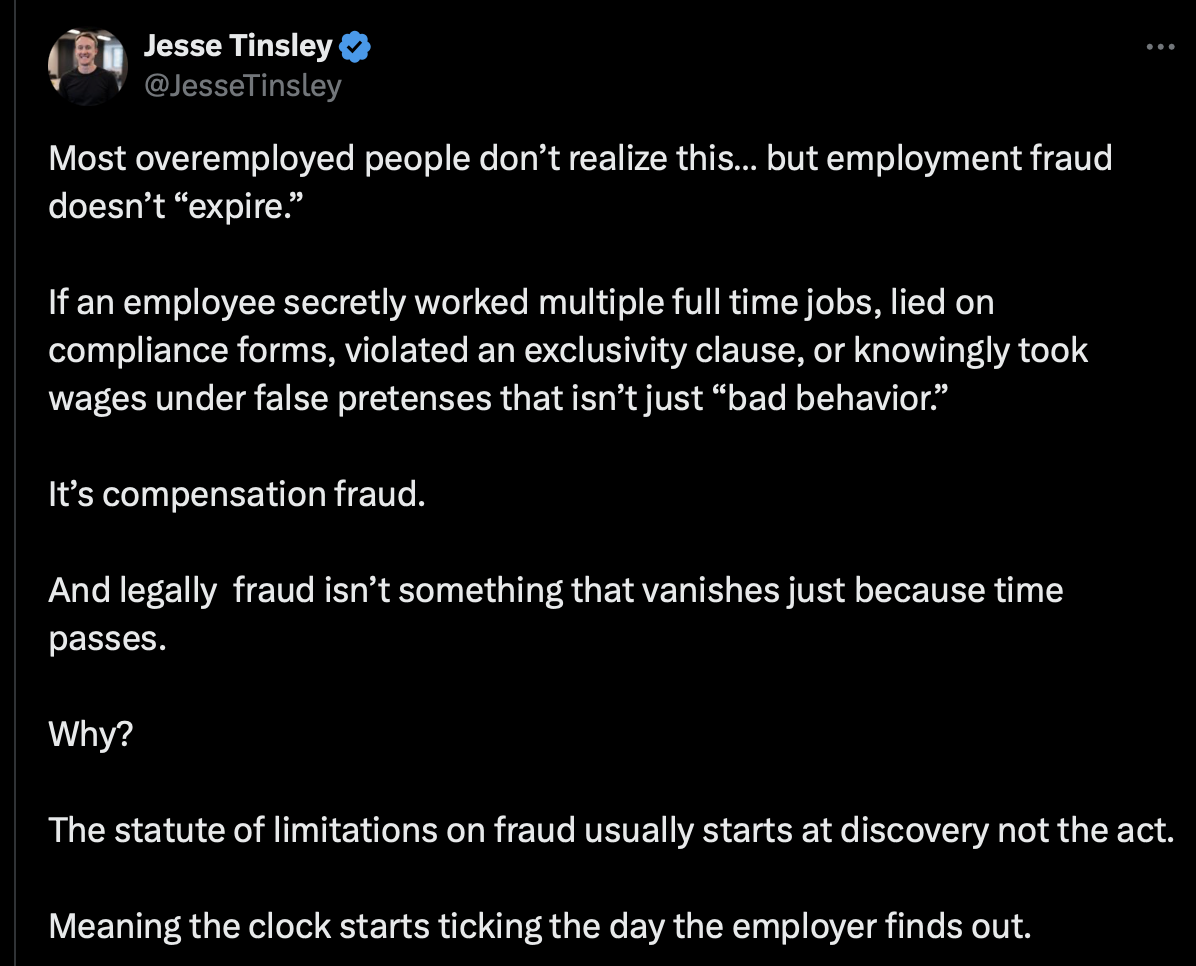
The CEO of Mainstreet.com posted that anyone secretly holding two full-time jobs is committing “compensation fraud,” that fraud “doesn’t expire,” and that employers now have an arsenal of legal weapons to pursue clawbacks, restitution, and even civil fraud claims.
Let’s look at “overemployment” from a legal perspective.
There are real legal risks when someone works two full-time jobs. There are scenarios where fraud, breach of duty, or IP exposure become very real.
But is every overemployed worker one discovery away from a multi-claim lawsuit?
Let’s breakdown the risks, the legal considerations, and what business leaders actually need to worry about.
1. “Fraud doesn’t expire.” Technically true. Practically…it depends.
If fraud statutes starts running at discovery, do employers have endless time to sue someone who worked two jobs? Partially true.
Fraud claims in many jurisdictions do have a “discovery rule.”
But:
Not all claims follow that rule.
Not every jurisdiction applies it the same way.
Fraud is a specific legal concept, not “this person annoyed me.”
“Discovery” isn’t whenever the employer feels like it discovered something. There’s a standard.
A better summary is: If an employee lies on compliance forms, falsifies certifications, or misrepresents conflicts, employers often can pursue claims even if the misconduct happened a while ago.
But this is not a bottomless well of liability.
Fraud isn’t the default. But when it exists, the clock doesn’t bail the employee out.
2. Working two jobs isn’t automatically fraud. Sometimes it’s just a bad idea.
NOT FRAUD
Working two remote jobs where no exclusivity clause exists
Doing mediocre work that disappoints a manager but doesn’t violate policy
Working unconventional hours but still meeting expectations
Side hustles that don’t violate duty of loyalty
POTENTIAL FRAUD
Lying on conflict-of-interest disclosures
Certifying “I have no other employment” when you do
Falsifying timecards
Misrepresenting job capacity
Using company systems or time to work a second job
Fraud is about deception, not existence. The mere fact of two jobs isn’t enough.
Unless, of course, the employee works for literal competitors.
3. IP contamination is a nightmare.
This is the part business leaders underestimate.
If an engineer, PM, senior analyst, or executive quietly holds a second job at an adjacent or competing company, you’re not dealing with “time theft.” You’re dealing with:
access to source code, roadmaps, models, strategy
trade secrets that follow them into Zoom meeting #2
overlapping deliverables that blur who created what
confidential docs floating between employers on a personal machine
unintentional “knowledge transfer” that suddenly becomes very intentional in litigation
Once two companies’ intellectual property gets mixed in the same person’s brain, there is no elegant way to untangle the mess.
I’ve seen this happen. It’s expensive. It’s stressful. It makes everyone feel like they’re living in a Cold War spy movie. And you absolutely can’t “return” contaminated knowledge.
The post calls this “radioactive.” That part is not wrong.
4. Yes, employers can pursue clawbacks, but not for everything
Clawbacks and restitution aren’t a new invention. Employers have always had mechanisms:
Contractual clawbacks (sign-on bonuses, equity, relocation, incentives)
Unjust enrichment theories
Negligent or intentional misrepresentation claims
Recoupment of wages in narrow scenarios (with many restrictions)
Offsets against future payments (when legally permissible)
But…Wage laws are strict.
You can’t say: “We think you underworked. Please return your paycheck.”
Wages aren’t refundable just because output didn’t match expectations. (If they were, we’d have no corporate executives left.)
Evidence must be airtight.
You need logs, timecards, credentials, overlapping meetings, device telemetry, system access—proof that would survive discovery.
Employers need to avoid overreach. Aggressive clawback attempts can trigger:
retaliation claims
wrongful termination suits
claims under state wage protection laws
discrimination arguments if enforcement isn’t consistent
privacy lawsuits if monitoring is excessive
Clawbacks are surgical instruments, not grenades.
5. “Fraud becomes provable” — maybe. But employers now have their own risks.
False positives
Most detection tools aren’t magic. People with caregiving responsibilities, disabilities, unconventional work styles, or global schedules may look like “dual-employees” on a graph.
Surveillance laws
Monitoring remote workers can be a legal minefield:
U.S. wiretap laws
Eavesdropping statutes
Biometric privacy laws
EU/UK worker monitoring limits
Works councils
Notice requirements everywhere
You can’t run a secret digital sting operation and expect smooth sailing.
Litigation risk
Botched investigations are expensive:
wrongful termination
retaliation
breach of contract
defamation
constructive discharge
whistleblower claims
The employer’s process matters as much as the employee’s conduct.
6. Overemployment isn’t new. Technology just makes it louder.
People have always held multiple jobs. But remote work + SaaS logs + digital trails + compliance attestations mean:
it’s easier to see
easier to prove
harder to deny
harder to ignore
Legally, the right question isn’t: “How many jobs do you have?”
It’s: “Did you lie, breach, leak, or misuse anything?”
7. What business leaders should actually do (without freaking out)
Clean up your employment agreements
exclusivity clauses
conflict disclosure requirements
IP ownership language
confidentiality obligations
invention assignment agreements
Add real conflict-of-interest certifications. Annual, signed, specific, not vague HR checkboxes.
Tighten system access controls. If employees have access to sensitive docs at midnight for one company and 2:00 AM for another…yeah.
Audit roles for IP exposure. Some roles (engineering, data science, strategy, product) carry inherent risk.
Build a disciplined investigation process. Not a rumor mill, something structured like a termination pipeline.
Don’t over-rely on detection vendors. Logs don’t tell stories. People do. Investigations require context.
Keep wage laws in mind. Do not attempt DIY clawbacks. Your payroll team will quit and your legal team will follow.
The better headline. Overemployment can involve fraud. It can involve IP theft. It can involve breach of contract.
But it can also involve:
a burned-out employee
a badly designed job
unclear expectations
or someone trying to pay rent in the year 2025
The legal tools exist but they are scalpels, not sledgehammers.
If companies want to take action, they need to do it carefully, thoughtfully, and with actual legal theory.
*This newsletter is informational only and is not intended as legal, tax, or investment advice